

Another Mother Tongue
Examines the life styles of gay men and women and discusses the role of gay culture in mainstream society.
ISBN: 0807079111
Author: Judy Grahn
Publisher: Beacon Press
Rating: 4.19
Read NowDownload Book
Examines the life styles of gay men and women and discusses the role of gay culture in mainstream society.
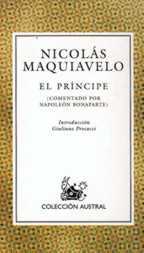
El Príncipe, de Nicolás de Maquiavelo (Florencia, 1469-1527) es, sin duda, un clásico en el sentido más literal del término, pero también uno de los libros peor entendidos de la historia de la literatura mundial. Baste pensar en el sentido negativo que en todas las lenguas se da a los términos "maquiavelismo" y "maquiavélico". Con ellos usualmente se designa un uso del poder político carente de prejuicios, en el que el fin justifica cualquier medio. No ha existido hombre poderoso en la tierra, desde Carlos V a Catalina de Médicis, de Luis XIV a Napoleón, hasta los dictadores de la época contemporánea, que no hayan sido acusados de leer secretamente El Príncipe para obtener consejo e inspiración. Sin embargo, puede decirse que Maquiavelo y el método de investigación que desarrolla significan para el origen del pensamiento político moderno lo que Leonardo da Vinci y el suyo significaron, en la misma época, para la ciencia. A partir de un vasto inventario de la historia de las épocas pasadas y de la contemporánea, Maquiavelo se esfuerza por extraer las relaciones, las constantes, aquellas leyes, en definitiva, que permiten los a los Estados, sean Repúblicas o Principados, durar o prosperar.
Esta edición va acompañada de los comentarios de Napoleón Bonaparte y precedida de una introducción del reconocido especialista Giuliano Procacci.
(extraído de fnac.es)
In these early years, Elvis, with a few irrepressible hip gyrations, became a scandalous heartthrob, teen idol, and rebel who captured the devotion of millions of fans.
The introduction is by the legendary music critic Lester Bangs (1949-1982), whose essays in magazines like Rolling Stone, Cream, and the Village Voice mark him as one of the most influential pop critics of the seventies.
The works of neurologist Oliver Sacks have a special place in the swarm of mind-brain studies. He has done as much as anyone to make nonspecialists aware of how much diversity gets lumped under the heading of "the human mind."
The stories in An Anthropologist on Mars are medical case reports not unlike the classic tales of Berton Roueché in The Medical Detectives. Sacks's stories are of "differently brained" people, and they have the intrinsic human interest that spurred his book Awakenings to be re-created as a Robin Williams movie.
The title story in Anthropologist is that of autistic Temple Grandin, whose own book Thinking in Pictures gives her version of how she feels--as unlike other humans as a cow or a Martian. The other minds Sacks describes are equally remarkable: a surgeon with Tourette's syndrome, a painter who loses color vision, a blind man given the ambiguous gift of sight, artists with memories that overwhelm "real life," the autistic artist Stephen Wiltshire, and a man with memory damage for whom it is always 1968.
Oliver Sacks is the Carl Sagan or Stephen Jay Gould of his field; his books are true classics of medical writing, of the breadth of human mentality, and of the inner lives of the disabled. --Mary Ellen Curtin
Ollie hides from his mother, slipping behind chairs, under a table, between two pillows, and then onto his mother's lap. This board book teaches prepositions while telling a warm story of a mother and son playing hide and seek. "This is a terrific board book, full of engagement, whimsy, and a healthy respect for the resourcefulness of one-year-olds. The companion volume -- Only One Ollie -- is just as fetching." -- Kirkus Reviews
"Coalescent Argumentation" is based on the concept that arguments can function from agreement, rather than disagreement. To prove this idea, Gilbert first discusses how several components--emotional, visceral (physical) and kisceral (intuitive) are utilized in an argumentative setting by people everyday. These components, also characterized as "modes," are vital to argumentative communication because they affect both the argument and the resulting outcome.
In addition to the components/modes, this book also stresses the goals in argumentation as a means for understanding one's own and one's opposer's positions. Gilbert argues that by viewing positions as complex human events involving a variety of communicative modes, we are better able to find commonalities across positions, and, therefore, move from conflict to resolution. By focusing on agreement and shared goals in all modes, arguers can coalesce diverse positions and more easily distinguish between minor or unrelated differences and core disagreements. This permits much greater latitude for locating shared beliefs, values, and attitudes that will lead to conflict resolution.
Includes 20 international holiday carols arranged for big-note piano: Bring a Torch, Jeannette, Isabella * Carol of the Birds * Fum, Fum, Fum * He Is Born * The Holly and the Ivy * Irish Carol * It Came Upon the Midnight Clear * Up on the Housetop * more.
